

Application
Vacuum in filling and sealing
Before filling, the container is evacuated – the bottle before the beer, the can before the preserved food, the battery cell before the electrolyte, the gas cylinder before the gas. According to Leybold, evacuation ensures clean, dry and bubble-free filling; according to Atlas Copco and Leybold, beer bottles are evacuated before CO2 flushing so that little oxygen remains in the beer. Below you can see how the application works, what vacuum the manufacturers name and which of their series are intended for it – 361 models from 5 manufacturers.
Compare 361 modelsHow it works
- 361Models
- 20Series
- 5Manufacturers
- up to 80,000 bottles/hBeer bottling with DRYVAC (Leybold)
Touch the points: each part of the system explains itself.
In short
Filling and sealing: the key facts
- Evacuation before fillingLeybold: before filling with gas or liquid, the container is evacuated so that filling is clean, dry and bubble-free. Becker names the evacuation of tubes, bottles and containers during filling.
- Beer bottlesLeybold: bottles are evacuated several times and flushed with CO2 to keep the oxygen low – with DRYVAC up to 80,000 bottles/h. According to Atlas Copco, the bottle is evacuated against oxidation before CO2 flushing and filling (GHS VSD+); Busch names DOLPHIN.
- ElectrolyteLeybold: repeated evacuation and partial filling for complete wetting, DRYVAC down to min. approx. 0.01 mbar. Busch: evacuate the cell, then fill it under vacuum (R5 RA, COBRA NC/NX, MINK MM/MV); Pfeiffer Vacuum names ACP.
- Foam and cappingAccording to Atlas Copco, the beer foam separator keeps foam out of the vacuum line (stainless steel, CIP, automatic draining); Atlas Copco names energy savings of up to 40% with it and describes capping bottles under vacuum as airtight against leakage and oxidation.
Operating principle
How it works: Filling and sealing
The drawing shows the basic principle in section. The systems and pumps of the individual manufacturers differ in detail.
- EvacuationThe closed container at the filling valve is evacuated – according to Leybold, beer bottles several times in alternation with CO2 flushing, battery cells down to min. approx. 0.01 mbar.
- FillingLiquid or gas flows into the evacuated container: clean, dry and bubble-free (Leybold); according to Leybold, cells are repeatedly partially filled; according to Busch, they are filled under vacuum.
- SealingAccording to Atlas Copco, bottles are capped airtight under vacuum against leakage and oxidation and cells are sealed without residual air and moisture; Elmo Rietschle names bottle filling and capping with vacuum control.
Vacuum and sizing
Filling and sealing: how much vacuum is needed
What the manufacturers say about pressure, pumping speed and sizing.
Which vacuum
For electrolyte filling with DRYVAC, Leybold names min. approx. 0.01 mbar.
What capacity
For beer bottling with DRYVAC, Leybold names up to 80,000 bottles per hour. With GHS VSD+ and the beer foam separator, Atlas Copco names energy savings of up to 40%.
What determines the sizing
Leybold assigns vacuum filling machines by size: SOGEVAC for small ones, NOVADRY for large ones. For bottles, Atlas Copco names GHS VSD+ and LRP VSD+, for beer GHS 402–1002; for electrolyte, Busch names R5 RA, COBRA NC/NX and MINK MM/MV; for bottles, Pfeiffer Vacuum names ACP, COMBI, DuoVane, HiLobe and HiScroll.
What the manufacturers point out
Oxygen: according to Atlas Copco, the beer bottle is evacuated against oxidation; according to Leybold, to keep the oxygen low. Foam: Atlas Copco’s beer foam separator keeps it out of the vacuum line. Wetting: according to Leybold, cells are repeatedly evacuated and partially filled. Residual moisture: according to Atlas Copco, cells are sealed under vacuum without residual air and moisture. Hygiene: Elmo Rietschle names vacuum control for hygienic filling.
Technology
Filling and sealing: the vacuum pumps the manufacturers name
Listed are the series the manufacturer itself names for this application. “Show only …” sets the filter of the product overview.
Liquid ring vacuum pumps
106 models · 20–16,160 m³/h
Oil-lubricated rotary vane vacuum pumps
93 models · 1.25–1,800 m³/h
Screw vacuum pumps
70 models · 63–5,136 m³/h
Roots vacuum pumps
47 models · 14–13,540 m³/h
Claw vacuum pumps
39 models · 18–1,150 m³/h
Scroll vacuum pumps
6 models · 6.1–43 m³/h
Becker names the application without naming a series for it. Elmo Rietschle names the application without naming a series for it.
Product overview
Filling and sealing: all 361 models compared
Use the filters on the left to narrow the selection – by manufacturer, technology and the models’ key figures, for 50 or 60 Hz.
Atlas Copco GHS VSD+ series 21 models
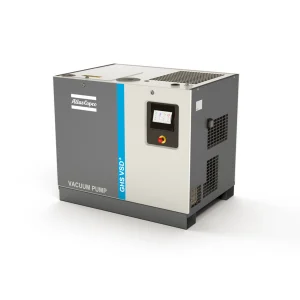 GHS 350 VSD+Pumping speed 400 m³/h 50 Hz400 m³/h 60 HzUltimate pressure 0.35 mbarRated motor power 5.5 kW 50 Hz5.5 kW 60 HzVariants 29
Atlas Copco LRP VSD+ series 3 models
 LRP 700 VSD+Pumping speed 740 m³/h 50 Hz740 m³/h 60 HzUltimate pressure 25 mbarRated motor power 18.5 kW 50 Hz18.5 kW 60 HzVariants 10
Busch COBRA Industry series 36 models
Busch DOLPHIN series 70 models
Busch MINK series 32 models
Busch PANDA/PUMA series 26 models
Busch R5 series 58 models
Edwards GV series 2 models
Edwards LR1A series 12 models
Edwards LR1C series 9 models
Edwards LR1D series 12 models
Edwards XDS series 2 models
Leybold CLAWVAC series 5 models
Leybold DRYVAC series 9 models
Leybold NOVADRY series 4 models
Leybold SOGEVAC series 23 models
Pfeiffer Vacuum ACP series 4 models
Pfeiffer Vacuum DuoVane series 12 models
Pfeiffer Vacuum HiLobe series 17 models
Pfeiffer Vacuum HiScroll series 4 models
No model matches these filters.
Atlas Copco GHS VSD+ series 21 models
Atlas Copco LRP VSD+ series 3 models
Busch COBRA Industry series 36 models
Busch DOLPHIN series 70 models
Busch MINK series 32 models
Busch PANDA/PUMA series 26 models
Busch R5 series 58 models
Edwards GV series 2 models
Edwards LR1A series 12 models
Edwards LR1C series 9 models
Edwards LR1D series 12 models
Edwards XDS series 2 models
Leybold CLAWVAC series 5 models
Leybold DRYVAC series 9 models
Leybold NOVADRY series 4 models
Leybold SOGEVAC series 23 models
Pfeiffer Vacuum ACP series 4 models
Pfeiffer Vacuum DuoVane series 12 models
Pfeiffer Vacuum HiLobe series 17 models
Pfeiffer Vacuum HiScroll series 4 models
Models a manufacturer no longer carries in its current range are listed in its “Outdated models” section.
Industries
Filling and sealing: where the manufacturers name it
The manufacturers list these uses on their own pages.
Beverages and bottling
According to Atlas Copco, the bottle is evacuated against oxidation before CO2 flushing and filling and is capped under vacuum, and the beer foam separator keeps foam out of the line (GHS VSD+, LRP VSD+); Elmo Rietschle names precise filling of beverages into bottles and vacuum control for hygienic filling.
Battery manufacturing
According to Leybold, cells are evacuated with DRYVAC down to min. approx. 0.01 mbar and repeatedly partially filled; according to Busch, the cell is evacuated and filled under vacuum (R5 RA, COBRA NC/NX, MINK MM/MV); Pfeiffer Vacuum names ACP, and according to Atlas Copco, cells are sealed under vacuum without residual air and moisture.
Food and beverage
For evacuating beer bottles before filling, Busch names DOLPHIN, and for bottle filling COBRA, MINK, PANDA, PUMA and R5; Edwards names filling for its LR liquid ring vacuum pumps.
Industrial gases
According to Leybold, gas cylinders are evacuated before filling; Edwards names evacuating and filling gas cylinders for XDS and GV; Busch and Pfeiffer Vacuum also name filling for industrial gases.
Packaging
Becker names the evacuation of tubes, bottles and containers during filling; Leybold names vacuum filling machines for sausage and alternative proteins with SOGEVAC and NOVADRY as well as bottle filling with CLAWVAC.
Mechanical engineering and manufacturing
Edwards names system evacuation and backfilling for the GV series.
Frequently asked questions
Filling and sealing: frequently asked questions
Why are bottles evacuated before filling?
So that no air remains in the container: according to Leybold, the container is evacuated before filling with gas or liquid so that filling is clean, dry and bubble-free. With beer, it is about oxygen – according to Atlas Copco, the bottle is evacuated against oxidation before CO2 flushing and filling; according to Leybold, it is evacuated several times and flushed with CO2 to keep the oxygen low.
How does beer bottling under vacuum work?
The bottle is evacuated at the filling valve, flushed with CO2 and filled – according to Leybold, several times in alternation, with DRYVAC up to 80,000 bottles per hour. For this, Atlas Copco names GHS VSD+ (for beer GHS 402–1002) and the beer foam separator, which keeps foam out of the vacuum line; Busch names DOLPHIN, and in its product finder for beverage bottling also HUCKEPACK and R5.
Which vacuum pump for filling systems?
For bottles, Atlas Copco names GHS VSD+ and LRP VSD+, Busch names COBRA, MINK, PANDA, PUMA and R5, Leybold names CLAWVAC, Pfeiffer Vacuum names ACP, COMBI, DuoVane, HiLobe and HiScroll, and Edwards names LR. For cans and preserved food, Atlas Copco names GHS VSD+; for vacuum filling machines, Leybold names SOGEVAC (small) and NOVADRY (large).
Which vacuum pump for electrolyte filling of battery cells?
Leybold names DRYVAC: repeated evacuation and partial filling for complete wetting, down to min. approx. 0.01 mbar. Busch names R5 RA, COBRA NC/NX and MINK MM/MV – evacuate the cell, then fill it under vacuum – and Pfeiffer Vacuum names ACP. Becker names evacuating batteries during filling, without a series.
How much vacuum does electrolyte filling need?
For electrolyte filling with DRYVAC, Leybold names min. approx. 0.01 mbar.
Oil-free or oil-lubricated for filling?
Both are named. Dry-running: Leybold DRYVAC, NOVADRY and CLAWVAC, Busch COBRA and MINK, Edwards XDS and GV, Pfeiffer Vacuum ACP, HiScroll and HiLobe. Oil-lubricated: Leybold SOGEVAC, Busch R5, Atlas Copco GHS VSD+, Pfeiffer Vacuum DuoVane. Liquid ring: Busch DOLPHIN, Atlas Copco LRP VSD+, Edwards LR. Leybold assigns SOGEVAC to small and NOVADRY to large vacuum filling machines.
What can be done if beer foam gets into the vacuum line?
For this, Atlas Copco names the beer foam separator as an accessory system for the GHS VSD+: it keeps foam out of the vacuum line, is made of stainless steel, is CIP-capable and empties itself; Atlas Copco names energy savings of up to 40% with it.
Which vacuum pump for vacuum filling machines (sausage)?
For vacuum filling machines for sausage and alternative proteins, Leybold names SOGEVAC for small and NOVADRY for large machines.
How are gas cylinders evacuated and filled?
According to Leybold, gas cylinders are evacuated before filling so that filling is clean, dry and bubble-free. Edwards names evacuating and filling gas cylinders for XDS and GV, and system evacuation and backfilling for the GV series.
Why is sealing done under vacuum?
Atlas Copco names two reasons: capping bottles under vacuum makes them airtight against leakage and oxidation, and battery cells are sealed under vacuum without residual air and moisture. Elmo Rietschle names bottle filling and capping with vacuum control for hygienic filling.
A single pump or a central vacuum system?
A central system in a room of its own keeps noise and heat away from production and matches its output to the demand. Central vacuum systems are planned and built by Eugen Theis Vakuum, a company of the Ehrler & Beck group – more under Central Vacuum.
Does Ehrler & Beck also supply spare parts and service?
Yes. Ehrler & Beck offers original spare parts and accessories as well as maintenance and repair.
Which pump suits your process?
Tell us the application, the medium and the volume – we advise you on selection, spare parts and service.
