

Application
Vacuum pumps for vacuum cooling
In vacuum cooling, the pressure above the warm product is lowered until its water evaporates – and evaporating water removes heat, as Becker describes it for bakery products. Leybold names rapid cooling above all for leafy vegetables, and also for sushi rice and bread; Becker names cooling times that are 20–40% shorter. Below you can see how the application works, what vacuum the manufacturers name and which of their series are intended for it – 310 models from 5 manufacturers.
Compare 310 modelsHow it works
- 310Models
- 17Series
- 5Manufacturers
- 20–40 %shorter cooling time for bakery products (Becker)
Touch the points: each part of the system explains itself.
In short
Vacuum cooling: the key facts
- Evaporation coolsBecker describes the principle of the vacuum cooling of bakery products in one sentence: evaporating water removes heat.
- 20–40% shorterFor the vacuum cooling of bakery products, Becker names cooling times that are 20–40% shorter and the series U and U4 with RBP for it, and VADS where needed in the line periphery.
- Vegetables, fruit, breadLeybold names rapid cooling above all for leafy vegetables, and also for sushi rice and bread; Atlas Copco names the vacuum cooling of vegetables, fruit and flowers.
- ManufacturersAtlas Copco, Becker, Busch, Edwards, Elmo Rietschle and Leybold list vacuum cooling. Edwards names it as rapid cooling in food processing, Elmo Rietschle as cooling in the chemical industry, both without a description.
Operating principle
How it works: Vacuum cooling
The drawing shows the basic principle in section. The systems and pumps of the individual manufacturers differ in detail.
- LoadingThe warm product – bakery products straight from the oven, vegetables after harvest – goes into the vacuum cooler, and the chamber is closed.
- EvacuationThe vacuum pump lowers the pressure. Under vacuum, the water in the product evaporates at a low temperature, and evaporating water removes heat (Becker).
- VentingOnce the target temperature is reached, the chamber is vented and the cooled product is removed. Becker names cooling times that are 20–40% shorter.
Vacuum and sizing
Vacuum cooling: how much vacuum is needed
What the manufacturers say about pressure, pumping speed and sizing.
Which vacuum
For bakery products, Becker names cooling times that are 20–40% shorter. Which pressure a system runs at depends on the product and the target temperature: the lower the pressure, the lower the temperature at which the water in the product evaporates.
Which pumps
Becker names U and U4 (oil-lubricated rotary vane) with the Roots pump RBP, plus VADS in the line periphery. Leybold names SOGEVAC (oil-lubricated rotary vane), NOVADRY and DRYVAC (screw vacuum pumps), Atlas Copco GHS VSD+ and DWS VSD+ (screw) with the Roots pump DRB, Busch R5, COBRA, DOLPHIN and PANDA/PUMA, Edwards LR1A, LR1C and LR1D (liquid ring).
What determines the sizing
Becker and Atlas Copco name pump systems made up of a backing pump and a Roots pump (U/U4 with RBP, GHS 1202–2002 with DRB): the Roots pump increases the pumping speed at low pressure when the water vapour from the product has to be removed in large quantities.
What the manufacturers point out
The manufacturers name different products: bakery products (Becker; Leybold lists baking and cooling for DRYVAC DV FP-r), leafy vegetables, sushi rice and bread (Leybold), vegetables, fruit and flowers (Atlas Copco). In all of them, water vapour is produced, which the pump has to remove as well.
Technology
Vacuum cooling: the vacuum pumps the manufacturers name
Listed are the series the manufacturer itself names for this application. “Show only …” sets the filter of the product overview.
Liquid ring vacuum pumps
103 models · 20–16,160 m³/h
Oil-lubricated rotary vane vacuum pumps
95 models · 3–1,800 m³/h
Screw vacuum pumps
78 models · 63–5,136 m³/h
Roots vacuum pumps
33 models · 250–12,000 m³/h
Screw compressors
1 model · 1,230 m³/h
Elmo Rietschle names the application without naming a series for it.
Product overview
Vacuum cooling: all 310 models compared
Use the filters on the left to narrow the selection – by manufacturer, technology and the models’ key figures, for 50 or 60 Hz.
Atlas Copco DRB series 4 models
 DRB 250Pumping speed 253 m³/h 50 Hz304 m³/h 60 HzUltimate pressure Rated motor power 1.1 kW 50 Hz1.1 kW 60 HzVariants 2
Atlas Copco DWS VSD+ series 6 models
Atlas Copco GHS VSD+ series 21 models
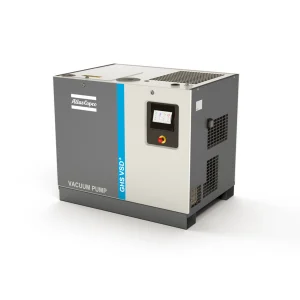 GHS 350 VSD+Pumping speed 400 m³/h 50 Hz400 m³/h 60 HzUltimate pressure 0.35 mbarRated motor power 5.5 kW 50 Hz5.5 kW 60 HzVariants 29
Becker RBP series 3 models
Becker U4 series 6 models
Becker U series 8 models
Becker VADS series 3 models
Busch COBRA Industry series 36 models
Busch DOLPHIN series 70 models
Busch PANDA/PUMA series 26 models
Busch R5 series 58 models
Edwards LR1A series 12 models
Edwards LR1C series 9 models
Edwards LR1D series 12 models
Leybold DRYVAC series 9 models
Leybold NOVADRY series 4 models
Leybold SOGEVAC series 23 models
No model matches these filters.
Atlas Copco DRB series 4 models
Atlas Copco DWS VSD+ series 6 models
Atlas Copco GHS VSD+ series 21 models
Becker RBP series 3 models
Becker U4 series 6 models
Becker U series 8 models
Becker VADS series 3 models
Busch COBRA Industry series 36 models
Busch DOLPHIN series 70 models
Busch PANDA/PUMA series 26 models
Busch R5 series 58 models
Edwards LR1A series 12 models
Edwards LR1C series 9 models
Edwards LR1D series 12 models
Leybold DRYVAC series 9 models
Leybold NOVADRY series 4 models
Leybold SOGEVAC series 23 models
Models a manufacturer no longer carries in its current range are listed in its “Outdated models” section.
Industries
Vacuum cooling: where the manufacturers name it
The manufacturers list these uses on their own pages.
Food and beverage
Busch lists vacuum cooling in its product finder with R5, COBRA, DOLPHIN and PANDA/PUMA; Edwards names rapid cooling in food processing with its liquid ring series LR1A, LR1C and LR1D.
Packaging
Becker names the vacuum cooling of bakery products (20–40% shorter cooling time, U/U4 with RBP) under primary packaging and food processing, Leybold the rapid cooling of leafy vegetables, sushi rice and bread with SOGEVAC, NOVADRY and DRYVAC under food processing and packaging.
Chemicals
Elmo Rietschle lists cooling among its applications for the chemical industry without describing it or naming a series.
Frequently asked questions
Vacuum cooling: frequently asked questions
How does vacuum cooling work?
The warm product goes into a sealed chamber, and the vacuum pump lowers the pressure. Under vacuum, the water in the product evaporates at a low temperature, and evaporating water removes heat – this is how Becker describes the principle for bakery products. At the end, the chamber is vented and the cooled product is removed.
How much faster is vacuum cooling?
For the vacuum cooling of bakery products, Becker names cooling times that are 20–40% shorter. Leybold speaks of rapid cooling.
Which vacuum pump for the vacuum cooling of bakery products?
Becker names its U and U4 series with the Roots pump RBP for this, and VADS where needed in the line periphery. Leybold lists baking and cooling with vacuum for DRYVAC DV FP-r and names bread among the products that are vacuum-cooled with SOGEVAC, NOVADRY and DRYVAC.
Which vacuum pump for vegetables, lettuce and fruit?
Leybold names vacuum cooling above all for leafy vegetables, and SOGEVAC, NOVADRY and DRYVAC for it. Atlas Copco names the vacuum cooling of vegetables, fruit and flowers for its Roots pump DRB and the screw vacuum pumps GHS VSD+ 1202–2002.
How much vacuum does vacuum cooling need?
In physical terms: the lower the pressure, the lower the temperature at which the water in the product evaporates. Which pressure a system runs at depends on the product and the target temperature.
Oil-free or oil-lubricated for vacuum cooling?
Both are named. Oil-lubricated rotary vane vacuum pumps: Becker U and U4, Leybold SOGEVAC, Busch R5; oil-lubricated screw vacuum pumps: Atlas Copco GHS VSD+. Dry-running: Leybold NOVADRY and DRYVAC, Atlas Copco DWS VSD+, Busch COBRA (screw) and PANDA/PUMA (Roots). With water as the operating liquid: Busch DOLPHIN and Edwards LR1A, LR1C, LR1D (liquid ring).
Why is bread cooled under vacuum?
Because evaporating water removes heat from the baked goods, as Becker describes it; Becker names cooling times that are 20–40% shorter. Leybold names bread alongside leafy vegetables and sushi rice among the products that are vacuum-cooled.
What happens to the water vapour from the product?
The vapour enters the line to the vacuum pump together with the extracted air. A separator retains condensate, and the pump discharges air and vapour through the exhaust. For the application, Becker and Atlas Copco name pump systems made up of a backing pump and a Roots pump (U/U4 with RBP, GHS 1202–2002 with DRB), which remove large gas volumes at low pressure.
Which manufacturers name vacuum cooling?
It is named by Atlas Copco (DRB, GHS VSD+, DWS VSD+), Becker (U, U4, RBP, VADS), Busch (R5, COBRA, DOLPHIN, PANDA/PUMA), Edwards (LR1A, LR1C, LR1D), Elmo Rietschle (without a series) and Leybold (SOGEVAC, NOVADRY, DRYVAC).
Is vacuum cooling also used in the chemical industry?
Elmo Rietschle lists cooling among its applications for the chemical industry, but does not describe it and names no series. Atlas Copco also names cooling and cooling systems for DWS VSD+ and GHS VSD+ 402–1002 without a description.
A single pump or a central vacuum system?
A central system in a room of its own keeps noise and heat away from production and matches its output to the demand. Central vacuum systems are planned and built by Eugen Theis Vakuum, a company of the Ehrler & Beck group – more under Central Vacuum.
Does Ehrler & Beck also supply spare parts and service?
Yes. Ehrler & Beck offers original spare parts and accessories as well as maintenance and repair.
Which pump suits your process?
Tell us the application, the medium and the volume – we advise you on selection, spare parts and service.
