

Application
Vacuum clamping on CNC machines
On CNC machines, vacuum holds the workpiece in place without damaging it. Here you can find out how clamping works, which vacuum the manufacturers name and which of their series are intended for it – 179 models from 4 manufacturers.
Compare 179 modelsHow clamping works
- 179Models
- 17Series
- 4Manufacturers
- 150–500 mbarabs. for clamping (Busch)
Touch the points: each part of the clamping system explains itself.
In short
Vacuum clamping and vacuum tables – the key facts
- PrincipleA sealed area under the workpiece is evacuated; the ambient air pressure presses the panel onto the table – at a pressure difference of 800 mbar with around 80 kN per square metre.
- Vacuum levelFor clamping, Busch lists 150 to 500 mbar (abs.), i.e. roughly 0.5 to 0.86 bar below ambient pressure. What matters is that the pump holds the vacuum even with leakage.
- PumpClaw, rotary vane (dry-running or oil-lubricated) and screw vacuum pumps. Atlas Copco names 200 to 300 m³/h for smaller tables and 800 to 900 m³/h for central supply.
- MaterialMDF and chipboard are porous and let air through; nesting with open contours increases the leakage (Becker). If the vacuum falls below a limit value, the panel can shift (Leybold).
Operating principle
How vacuum clamping works on the vacuum table
Leybold describes two main methods: the grid table, on which a sealing cord delimits the area under the panel, and tables with vacuum pods, which are turned up or down depending on the shape of the part. Busch describes clamping systems made of several suction cups that adapt to the shape and size of the workpiece.
The drawing shows the basic principle in section. The clamping tables and pumps of the individual manufacturers differ in detail.
- SealingA sealing cord, suction cups or pods delimit the area under the workpiece.
- EvacuatingThe pump draws the air out from under the panel. At a pressure difference of 800 mbar, the ambient air presses on every square metre with around 80 kN – the weight of just over 8 tonnes.
- HoldingThe vacuum must remain stable throughout the entire machining process. If it falls below a certain value, the panel can shift (Leybold).
Vacuum and sizing
How much vacuum a vacuum table needs
The lower the absolute pressure under the workpiece, the greater the pressure difference to the surroundings and the more firmly the panel is pressed down.
Vacuum in CNC processes according to Busch (mbar abs.)
Suction capacity under leakage
Becker: it is not the ultimate pressure alone that decides, but the suction capacity available under real leakage conditions. Nesting applications generally need high suction volume flows.
What determines the size
Becker names the panel size, the material density, the machining strategy and the total leakage. Atlas Copco: larger workpieces need larger suction cups.
Guide values for the volume flow
Atlas Copco names pumps with 200 to 300 m³/h for smaller tables, and pumps with 800 to 900 m³/h for supplying several tables centrally.
Speed on demand
Frequency-controlled pumps adapt the suction capacity to the workpiece size and the material (Becker VARIAIR) and compensate for falling suction capacity when there are leaks (Atlas Copco VSD). Leybold names the VAControl CAB control, which lowers the speed between and during cycles as soon as the required vacuum is reached.
Technology
Which vacuum pump for the CNC router? The manufacturers’ series
Listed are the series the manufacturer itself names for vacuum clamping or CNC milling. “Show only …” sets the filter of the product overview.
Oil-lubricated rotary vane vacuum pumps
58 models · 3–1,800 m³/h
Dry-running rotary vane vacuum pumps
49 models · 3–560 m³/h
Claw vacuum pumps
47 models · 18–1,150 m³/h
Screw vacuum pumps
25 models · 63–5,136 m³/h
In addition, Atlas Copco names its DZS claw vacuum pumps for CNC milling and its side channel blowers of the DB series (DBS, DBSt, DBD, DBDt) for vacuum tables; the DZS series also includes pressure versions and is therefore not in the list below. Elmo Rietschle names CNC fixing as an application in wood processing without specifying a series for it.
Product overview
All 179 models for vacuum clamping compared
Use the filters on the left to narrow the selection – by manufacturer, technology and the models’ key figures, for 50 or 60 Hz.
Atlas Copco DVS series 10 models
 DVS 5Pumping speed 5 m³/h 50 Hz6 m³/h 60 HzUltimate pressure 120 mbarRated motor power 0.12 kW 50 Hz0.15 kW 60 HzVariants 3
Atlas Copco GHS VSD+ series 21 models
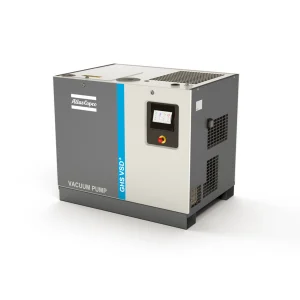 GHS 350 VSD+Pumping speed 400 m³/h 50 Hz400 m³/h 60 HzUltimate pressure 0.35 mbarRated motor power 5.5 kW 50 Hz5.5 kW 60 HzVariants 29
Becker BCV series 7 models
Becker KVT series 4 models
Becker KVX series 4 models
Becker VARIAIR BCV series 3 models
Becker VARIAIR KVT series 3 models
Becker VARIAIR KVX series 3 models
Becker VARIAIR VTLF series 2 models
Becker VARIAIR VXLF series 2 models
Becker VTLF series 6 models
Becker VXLF series 5 models
Busch MINK series 32 models
Busch R5 series 58 models
Busch SECO series 10 models
Leybold CLAWVAC series 5 models
Leybold NOVADRY series 4 models
No model matches these filters.
Atlas Copco DVS series 10 models
Atlas Copco GHS VSD+ series 21 models
Becker BCV series 7 models
Becker KVT series 4 models
Becker KVX series 4 models
Becker VARIAIR BCV series 3 models
Becker VARIAIR KVT series 3 models
Becker VARIAIR KVX series 3 models
Becker VARIAIR VTLF series 2 models
Becker VARIAIR VXLF series 2 models
Becker VTLF series 6 models
Becker VXLF series 5 models
Busch MINK series 32 models
Busch R5 series 58 models
Busch SECO series 10 models
Leybold CLAWVAC series 5 models
Leybold NOVADRY series 4 models
Models a manufacturer no longer carries in its current range are listed in its “Outdated models” section.
Industries
Vacuum clamping in other industries
Vacuum does not only hold wood. The manufacturers list these uses on their pages.
Woodworking
Panels on CNC machines and at manual workstations – named by Atlas Copco, Becker, Busch, Elmo Rietschle and Leybold.
Glass, plastics and sheet metal
Clamping of panel material such as glass, plastic or sheet metal (Becker).
Printing and paper
Printing plates in exposure units and CTP systems, print and paper products on cutting tables and screen printing machines (Becker).
Textiles and leather
Textiles and leather on cutting tables (Becker). On fabric cutting tables, an air cushion positions the fabric and vacuum holds it during cutting (Elmo Rietschle).
Stone
Vacuum gives the stone a secure hold during cutting and polishing (Atlas Copco).
Electronics and semiconductors
Fixing of components in test processes in the semiconductor industry (Becker).
Fish processing
A holding vacuum fixes the fish on the filleting table so that the cuts stay precise (Busch).
Frequently asked questions
Frequently asked questions about the vacuum table and vacuum clamping
How does a vacuum table on a CNC router work?
A sealed area under the workpiece is evacuated: on the grid table, a sealing cord in the grooves delimits the area; with suction cups and vacuum pods, it is the area of the suction cups. The vacuum pump draws out the air underneath, and the ambient air pressure presses the panel onto the table – at a pressure difference of 800 mbar with around 80 kN per square metre, the weight of just over 8 tonnes. The drawing above shows the set-up in section.
How much vacuum does a vacuum table need?
For clamping on CNC machines, Busch lists 150 to 500 mbar (abs.), i.e. roughly 0.5 to 0.86 bar below ambient pressure. What matters is that the pump holds this vacuum even with leakage – in nesting with open contours, the leakage is high. For moving and lifting panels, Busch lists 300 to 900 mbar (abs.).
Which vacuum pump is suitable for a CNC router?
Claw vacuum pumps (Becker BCV, Busch MINK, Leybold CLAWVAC, Atlas Copco DZS), dry-running rotary vane vacuum pumps (Becker VTLF, VXLF, KVT, KVX, Busch SECO, Atlas Copco DVS), oil-lubricated rotary vane vacuum pumps (Busch R5) and screw vacuum pumps (Atlas Copco GHS VSD+, Leybold NOVADRY). Becker lists for its series: BCV 275 to 600 m³/h and 150 to 200 mbar, VTLF and VXLF 280 to 570 m³/h and 200 to 350 mbar, KVT and KVX 67 to 145 m³/h and 100 mbar. All models are in the product overview.
How large does the vacuum pump need to be?
Atlas Copco names 200 to 300 m³/h for smaller tables and 800 to 900 m³/h for pumps that supply several tables centrally. As the factors that determine the sizing, Becker names the panel size, the material density, the machining strategy and the total leakage.
Is a side channel blower suitable as a vacuum pump for the vacuum table?
For clamping on CNC machines, Becker and Busch do not name side channel blowers but claw, rotary vane and screw vacuum pumps. They list side channel blowers for tasks where a weaker vacuum is sufficient: Busch the SAMOS for lifting and feeding panels and for sawdust extraction (300 to 900 mbar abs.), Becker the SV series for vacuum lifters. Atlas Copco names its side channel blowers of the DB series for vacuum tables.
Oil-free or oil-lubricated – which pump for the clamping table?
For clamping, Busch names the dry-running MINK and SECO as well as the oil-lubricated R5. For CNC clamping, Becker names the oil-free BCV, VTLF, VXLF, KVT and KVX and, for dust-intensive applications, recommends pumps with a large filter area in which no oil can combine with wood dust to form deposits. For CNC milling and clamping, Atlas Copco names the dry-running DVS, the DZS claw vacuum pump and the GHS VSD+ screw vacuum pump.
Grid table, suction cups or vacuum pods – what is the difference?
Leybold describes two main methods: the grid table, on which a sealing cord in the grooves delimits the area under the panel, and tables with vacuum pods, which are turned up or down depending on the shape of the part. Busch describes clamping systems made of several suction cups that adapt to the shape and size of the workpiece; Atlas Copco: larger workpieces need larger suction cups.
Why does the workpiece shift during milling?
As typical causes, Becker names too little vacuum with porous materials such as MDF or chipboard and high leakage in nesting. Leybold: if the vacuum falls below a certain value, the panel can shift and the cut suffers. Frequency-controlled pumps compensate for falling suction capacity when there are leaks (Atlas Copco VSD).
Why does the vacuum table hold MDF or chipboard less well than dense materials?
MDF and chipboard are porous: air flows in continuously through the material, and the vacuum under the panel remains weaker than with dense materials. Becker names too little vacuum with porous materials as a typical cause of shifting workpieces and lists its series as holding MDF, chipboard, plywood and solid wood even with high leakage.
A single pump or a central vacuum system?
Atlas Copco considers pumps directly at the machine sensible for smaller applications with a few CNC machines, and central systems often the better solution in larger production plants. Central vacuum systems are planned and built by Eugen Theis Vakuum, a company of the Ehrler & Beck group – more under Central Vacuum.
Does Ehrler & Beck also supply spare parts and service?
Yes. Ehrler & Beck offers original spare parts and accessories as well as maintenance and repair.
Which pump suits your clamping table?
Tell us the table size, the material and the number of machines – we advise you on selection, spare parts and service.
