

Application
Vacuum pumps for 3D printing and additive manufacturing
In metal 3D printing, powder is melted layer by layer with a laser or electron beam – in a build chamber without air. In electron beam melting, according to Pfeiffer Vacuum, the vacuum prevents oxidation and guides the beam; in laser melting systems, according to Becker, the build chamber is evacuated before it is filled with inert gas. Below you can see how the application works, what vacuum the manufacturers name and which of their series are intended for it – 179 models from 3 manufacturers.
Compare 179 modelsHow it works
- 179Models
- 9Series
- 3Manufacturers
- ~5×10⁻⁵ hPaElectron beam melting (Pfeiffer Vacuum)
Touch the points: each part of the system explains itself.
In short
3D printing and additive manufacturing: the key facts
- Electron beamFor electron beam melting, Pfeiffer Vacuum names about 5×10⁻⁵ hPa: the vacuum prevents oxidation and guides the beam.
- Inert gasBecker: the build chamber is evacuated before it is filled with inert gas; in laser melting 3D printers, the shielding gas is extracted, filtered and returned – with SV and VASF.
- Leak rateFor inert gas recirculation, Becker names a leak rate below 1×10⁻⁵ mbar·l/s.
- Stable vacuumFor additive manufacturing, Busch names stable vacuum conditions and the series COBRA, PANDA/PUMA and R5 (in the product finder).
Operating principle
How it works: 3D printing and additive manufacturing
The drawing shows the basic principle in section. The systems and pumps of the individual manufacturers differ in detail.
- EvacuationThe build chamber is pumped down – in electron beam melting, according to Pfeiffer Vacuum, to about 5×10⁻⁵ hPa; in laser melting, according to Becker, before it is filled with inert gas.
- MeltingA laser or electron beam melts the powder layer by layer. According to Pfeiffer Vacuum, the vacuum prevents oxidation and guides the beam; Busch names stable vacuum conditions.
- RemovalAfter the build process, the build chamber is vented and the part is lifted out of the powder. Becker names conveying metal powder under inert gas with SV and VASF.
Vacuum and sizing
3D printing and additive manufacturing: how much vacuum is needed
What the manufacturers say about pressure, pumping speed and sizing.
Which vacuum
For electron beam melting, Pfeiffer Vacuum names about 5×10⁻⁵ hPa. Busch names stable vacuum conditions; Becker names a leak rate below 1×10⁻⁵ mbar·l/s for inert gas recirculation.
Inert gas
For laser melting 3D printers, Becker describes three tasks: evacuating the build chamber before filling with inert gas, extracting, filtering and returning the shielding gas, and conveying metal powder under inert gas – the last two with SV and VASF.
Which pumps
Busch names COBRA, PANDA/PUMA and R5 (in the product finder), Pfeiffer Vacuum names ACP, DuoVane, HiLobe and HiScroll as well as the COMBI family, and Becker names SV and VASF.
Technology
3D printing and additive manufacturing: the vacuum pumps the manufacturers name
Listed are the series the manufacturer itself names for this application. “Show only …” sets the filter of the product overview.
Oil-lubricated rotary vane vacuum pumps
70 models · 1.25–1,800 m³/h
Roots vacuum pumps
47 models · 14–13,540 m³/h
Screw vacuum pumps
36 models · 70–4,652 m³/h
Side channel blowers
22 models · 24–1,050 m³/h
Scroll vacuum pumps
4 models · 6.1–43 m³/h
Product overview
3D printing and additive manufacturing: all 179 models compared
Use the filters on the left to narrow the selection – by manufacturer, technology and the models’ key figures, for 50 or 60 Hz.
Becker SV series 16 models
 SV 130/2Pumping speed 70 m³/h 50 Hz85 m³/h 60 HzUltimate pressure 620 – 830 mbarRated motor power 0.55 – 1.1 kW 50 Hz0.66 – 1.3 kW 60 HzVariants 11
 SV 200/2Pumping speed 90 m³/h 50 Hz110 m³/h 60 HzUltimate pressure 670 mbarRated motor power 1.1 – 1.5 kW 50 Hz1.3 – 1.8 kW 60 HzVariants 9SV 130/1Pumping speed 130 m³/h 50 Hz160 m³/h 60 HzUltimate pressure 760 – 925 mbarRated motor power 0.55 – 1.5 kW 50 Hz0.66 – 1.8 kW 60 HzVariants 19SV 200/1Pumping speed 180 m³/h 50 Hz230 m³/h 60 HzUltimate pressure 785 – 850 mbarRated motor power 1.1 – 1.5 kW 50 Hz1.3 – 1.8 kW 60 HzVariants 9
 SV 400/2Pumping speed 195 m³/h 50 Hz235 m³/h 60 HzUltimate pressure 560 mbarRated motor power 3 – 5.5 kW 50 Hz3.6 – 6.6 kW 60 HzVariants 12
 SV 700/2Pumping speed 375 m³/h 50 Hz435 m³/h 60 HzUltimate pressure 600 mbarRated motor power 7.5 kW 50 Hz9 kW 60 HzVariants 3SV 400/1Pumping speed 390 m³/h 50 Hz470 m³/h 60 HzUltimate pressure 685 – 790 mbarRated motor power 3 – 5.5 kW 50 Hz3.6 – 6.6 kW 60 HzVariants 12SV 700/1Pumping speed 750 m³/h 50 Hz900 m³/h 60 HzUltimate pressure 660 – 800 mbarRated motor power 5.5 – 11 kW 50 Hz6.6 – 13.2 kW 60 HzVariants 10
Becker VASF series 6 models
Busch COBRA Industry series 36 models
 COBRA NS 0070 CPumping speed 70 m³/h 50 Hz85 m³/h 60 HzUltimate pressure 0.03 mbarRated motor power 4 kW 50 Hz4.4 kW 60 HzVariants
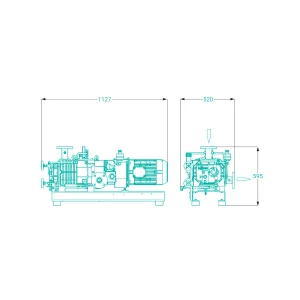 COBRA NC 0100 BPumping speed 110 m³/h 50 Hz130 m³/h 60 HzUltimate pressure 0.05 mbarRated motor power 3.5 kW 50 Hz4.8 kW 60 HzVariants 4
Busch PANDA/PUMA series 26 models
Busch R5 series 58 models
Pfeiffer Vacuum ACP series 4 models
Pfeiffer Vacuum DuoVane series 12 models
Pfeiffer Vacuum HiLobe series 17 models
Pfeiffer Vacuum HiScroll series 4 models
No model matches these filters.
Becker SV series 16 models
Becker VASF series 6 models
Busch COBRA Industry series 36 models
Busch PANDA/PUMA series 26 models
Busch R5 series 58 models
Pfeiffer Vacuum ACP series 4 models
Pfeiffer Vacuum DuoVane series 12 models
Pfeiffer Vacuum HiLobe series 17 models
Pfeiffer Vacuum HiScroll series 4 models
Models a manufacturer no longer carries in its current range are listed in its “Outdated models” section.
Industries
3D printing and additive manufacturing: where the manufacturers name it
The manufacturers list these uses on their own pages.
Metallurgy and heat treatment
Busch and Pfeiffer Vacuum list 3D printing under metallurgy and heat treatment – metal powder is melted in the build chamber without oxygen, according to Pfeiffer Vacuum at about 5×10⁻⁵ hPa in electron beam melting.
Automotive and transport
Busch names additive manufacturing for automotive and transport, with stable vacuum conditions and COBRA, PANDA/PUMA and R5; Pfeiffer Vacuum also lists 3D printing in this industry.
Mechanical engineering and manufacturing
For mechanical engineering, Becker names laser melting 3D printers: evacuating the build chamber, recirculating the shielding gas and conveying metal powder under inert gas with SV and VASF.
Medical and healthcare
Pfeiffer Vacuum also lists 3D printing under the medical and healthcare sector, without describing it there in more detail.
Frequently asked questions
3D printing and additive manufacturing: frequently asked questions
How does 3D printing in a vacuum work?
Metal powder is melted layer by layer in the build chamber. In electron beam melting, according to Pfeiffer Vacuum, the build chamber is evacuated to about 5×10⁻⁵ hPa – the vacuum prevents oxidation and guides the beam. In laser melting systems, according to Becker, the build chamber is evacuated and then filled with inert gas.
Why does electron beam melting need a vacuum?
According to Pfeiffer Vacuum, the vacuum prevents oxidation of the powder and guides the electron beam. Pfeiffer Vacuum names about 5×10⁻⁵ hPa for this.
How much vacuum does a metal 3D printer need?
For electron beam melting, Pfeiffer Vacuum names about 5×10⁻⁵ hPa. Busch names stable vacuum conditions. For laser melting systems, Becker names a leak rate below 1×10⁻⁵ mbar·l/s for inert gas recirculation.
Which vacuum pump for 3D printing?
Busch names COBRA, PANDA/PUMA and R5, Pfeiffer Vacuum names ACP, DuoVane, HiLobe and HiScroll as well as the COMBI family. Becker names SV and VASF for inert gas recirculation and for conveying metal powder under inert gas; Becker lists evacuating the build chamber without naming a series.
Why is the build chamber evacuated before the inert gas is let in?
Becker lists evacuating the build chamber before filling with inert gas as an application, without describing it in more detail. If the air is pumped out beforehand, less oxygen remains in the build chamber when it is filled with inert gas.
What is inert gas recirculation in laser melting?
According to Becker, the shielding gas in laser melting 3D printers is extracted, filtered and returned. Becker names SV and VASF and a leak rate below 1×10⁻⁵ mbar·l/s for this.
What leak rate does the build chamber need?
For inert gas recirculation in laser melting 3D printers, Becker names a leak rate below 1×10⁻⁵ mbar·l/s. For electron beam melting, Pfeiffer Vacuum names a pressure of about 5×10⁻⁵ hPa.
Which pump conveys metal powder under inert gas?
Becker lists conveying metal powder under inert gas with SV and VASF, without describing it in more detail.
Which series does Busch name for additive manufacturing?
Busch names COBRA, PANDA/PUMA and R5 and describes stable vacuum conditions as a requirement. Busch’s product finder lists products from COBRA and R5 for 3D printing.
A single pump or a central vacuum system?
A central system in a room of its own keeps noise and heat away from production and matches its output to the demand. Central vacuum systems are planned and built by Eugen Theis Vakuum, a company of the Ehrler & Beck group – more under Central Vacuum.
Does Ehrler & Beck also supply spare parts and service?
Yes. Ehrler & Beck offers original spare parts and accessories as well as maintenance and repair.
Which pump suits your process?
Tell us the application, the medium and the volume – we advise you on selection, spare parts and service.
