

Application
Vacuum pumps for clay degassing
In clay degassing the air is drawn out of the moist clay body before it is pressed into bricks, tiles or shaped parts. In the degassing chamber of the vacuum extruder the pressure falls, air bubbles escape, and according to Atlas Copco the clay becomes denser – with fewer holes and blisters in the finished part. Below you can see how the application works, what vacuum the manufacturers name and which of their series are intended for it – 44 models from 3 manufacturers.
- 44Models
- 5Series
- 3Manufacturers
- 2Industries
Touch the points: each part of the system explains itself.
In short
Clay degassing: the key facts
- Denser clayAtlas Copco describes the degassing of moist clay as a pressure reduction in the degassing chamber that makes the clay denser.
- Fewer defectsAtlas Copco names the avoidance of holes and blisters and thus fewer surface defects on the brick or shaped part.
- Vacuum extruderElmo Rietschle describes that vacuum extruders remove air bubbles from the clay mixture; the manufacturer also lists extrusion, forming and homogeneous clay mixing, without describing them.
- ManufacturersAtlas Copco names GHS VSD+ and GVS VSD+, Edwards EOSi for bricks and tiles, Leybold CLAWVAC and NOVADRY for ceramics and bricks; Elmo Rietschle describes the application without naming a series.
Operating principle
How it works: Clay degassing
The drawing shows the basic principle in section. The systems and pumps of the individual manufacturers differ in detail.
- MixingThe clay is prepared with water and additives. Elmo Rietschle lists homogeneous clay mixing as a task for vacuum in ceramics.
- DegassingIn the degassing chamber of the vacuum extruder the vacuum pump lowers the pressure. Air bubbles leave the clay mixture, and according to Atlas Copco the clay becomes denser.
- FormingThe degassed mass is extruded or pressed – into bricks, tiles or shaped parts. Atlas Copco names fewer holes and blisters and fewer surface defects as the result.
Vacuum and sizing
Clay degassing: how much vacuum is needed
What the manufacturers say about pressure, pumping speed and sizing.
What vacuum
Atlas Copco describes the pressure reduction in the degassing chamber without giving a value; the ultimate pressure the named series can reach is given on the product pages.
What determines the sizing
Atlas Copco distinguishes batch processing, in which large quantities of clay are degassed at the same time (GHS VSD+), from shaped parts and extrusion (GVS VSD+, GHS). The quantity and throughput of clay determine the size of the pump.
What the manufacturers point out
Atlas Copco explicitly refers to moist clay. The extracted air therefore carries water vapour and clay particles with it – separators and filters upstream of the pump retain both.
Technology
Clay degassing: the vacuum pumps the manufacturers name
Listed are the series the manufacturer itself names for this application. “Show only …” sets the filter of the product overview.
Screw vacuum pumps
35 models · 63–5,136 m³/h
Claw vacuum pumps
5 models · 65–950 m³/h
Oil-lubricated rotary vane vacuum pumps
4 models · 78–351 m³/h
Elmo Rietschle names the application without naming a series for it.
Product overview
Clay degassing: all 44 models compared
Use the filters on the left to narrow the selection – by manufacturer, technology and the models’ key figures, for 50 or 60 Hz.
Atlas Copco GHS VSD+ series 21 models
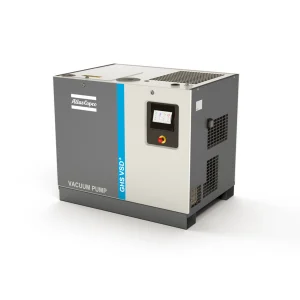 GHS 350 VSD+Pumping speed 400 m³/h 50 Hz400 m³/h 60 HzUltimate pressure 0.35 mbarRated motor power 5.5 kW 50 Hz5.5 kW 60 HzVariants 29
Atlas Copco GVS VSD+ series 4 models
 GVS 80 VSD+Pumping speed 78 m³/h 50 Hz78 m³/h 60 HzUltimate pressure 0.5 mbarRated motor power 2.2 kW 50 Hz2.2 kW 60 HzVariants 1
 GVS 120 VSD+Pumping speed 117 m³/h 50 Hz117 m³/h 60 HzUltimate pressure 0.5 mbarRated motor power 3.7 kW 50 Hz3.7 kW 60 HzVariants 1
Edwards EOSi series 10 models
Leybold CLAWVAC series 5 models
Leybold NOVADRY series 4 models
No model matches these filters.
Atlas Copco GHS VSD+ series 21 models
Atlas Copco GVS VSD+ series 4 models
Edwards EOSi series 10 models
Leybold CLAWVAC series 5 models
Leybold NOVADRY series 4 models
Models a manufacturer no longer carries in its current range are listed in its “Outdated models” section.
Industries
Clay degassing: where the manufacturers name it
The manufacturers list these uses on their own pages.
Glass, ceramics and stone
Atlas Copco describes clay degassing for bricks and ceramics with GHS VSD+ and GVS VSD+, Elmo Rietschle names vacuum extruders, extrusion, forming and homogeneous clay mixing, Leybold lists ceramics, bricks and clay degassing with CLAWVAC and NOVADRY.
Mechanical engineering and manufacturing
Edwards lists bricks and tiles as a use of the oil-lubricated screw vacuum pump EOSi, without describing the process.
Frequently asked questions
Clay degassing: frequently asked questions
Why is clay degassed before pressing?
Because trapped air leaves defects in the finished brick or shaped part. Atlas Copco names the purpose of clay degassing as avoiding holes and blisters and reducing surface defects; the pressure reduction in the degassing chamber makes the clay denser.
How does a vacuum extruder work?
The clay mixture is conveyed into a degassing chamber in which a vacuum pump lowers the pressure. According to Elmo Rietschle, vacuum extruders thus remove the air bubbles from the clay mixture. The degassed mass is then extruded and formed into bricks, tiles or shaped parts.
Which vacuum pump is suitable for clay degassing?
Atlas Copco names the GHS VSD+ series for batch processing and the degassing of moist clay, and GVS VSD+ and GHS for shaped parts and extrusion. Edwards names EOSi for bricks and tiles, Leybold CLAWVAC and NOVADRY for ceramics, bricks and clay degassing. Elmo Rietschle describes the application but assigns no series to it.
How much vacuum does clay degassing need?
Atlas Copco describes degassing as a pressure reduction in the degassing chamber that makes the clay denser. The ultimate pressure the named series reach is given on their product pages.
Oil-free or oil-lubricated for clay degassing?
Both are named. With GHS VSD+ Atlas Copco names oil-lubricated screw vacuum pumps and with GVS VSD+ oil-lubricated rotary vane vacuum pumps, Edwards with EOSi likewise oil-lubricated screw vacuum pumps. Leybold names CLAWVAC, a dry-running claw vacuum pump, and NOVADRY, a dry screw vacuum pump.
What to do if bricks show holes or blisters?
Holes and blisters are caused by air that has remained in the clay. Atlas Copco names clay degassing as a means against holes and blisters and for fewer surface defects. If degassing is in place, check whether the vacuum pump reaches the required pressure in the chamber and whether separators and filters are clear.
Can large quantities of clay be degassed at once?
Yes. Atlas Copco names batch processing, in which large quantities of clay are degassed at the same time, and assigns the GHS VSD+ series to it. For shaped parts and extrusion Atlas Copco names GVS VSD+ and GHS.
What role does the moisture of the clay play?
Atlas Copco explicitly refers to the degassing of moist clay. The extracted air therefore contains water vapour and can carry clay particles with it; separators and filters upstream of the vacuum pump keep both away from the pump.
A single pump or a central vacuum system?
A central system in a room of its own keeps noise and heat away from production and matches its output to the demand. Central vacuum systems are planned and built by Eugen Theis Vakuum, a company of the Ehrler & Beck group – more under Central Vacuum.
Does Ehrler & Beck also supply spare parts and service?
Yes. Ehrler & Beck offers original spare parts and accessories as well as maintenance and repair.
Which pump suits your process?
Tell us the application, the medium and the volume – we advise you on selection, spare parts and service.
