

Application
Vacuum in glass forming
In glass forming in IS machines, the hot glass gob is formed in the mould; the vacuum draws the air out of the mould through fine holes so that the glass settles against the mould wall faster. Atlas Copco describes this for the GHS VSD+ with less compressed air; Leybold lists glass bottle forming for the NOVADRY. Below you can see how the application works, what vacuum the manufacturers name and which of their series are intended for it – 25 models from 2 manufacturers.
- 25Models
- 2Series
- 2Manufacturers
- 150–300 mbarVacuum at the mould (Atlas Copco)
Touch the points: each part of the system explains itself.
In short
Glass forming: the key facts
- Mould under vacuumAtlas Copco describes glass forming in IS machines as follows: the moulds are evacuated through fine holes, and forming is faster and needs less compressed air.
- 150–300 mbarFor the vacuum at the mould, Atlas Copco names 150–300 mbar and calculates with 100–250 m³/h per section of the IS machine.
- Up to 4,000 m³/hPer IS machine, Atlas Copco names 600–1,500 m³/h, up to 4,000 m³/h, and provides the GHS VSD+ screw vacuum pumps with frequency control for this.
- Less compressed airAccording to Atlas Copco, forming with vacuum needs up to five times less air and energy, because the vacuum draws the glass into the mould and less compressed air is needed.
Operating principle
How it works: Glass forming
The drawing shows the basic principle in section. The systems and pumps of the individual manufacturers differ in detail.
- LoadingThe glass gob drops into the blank mould and passes as a parison into the mould of the IS machine.
- EvacuatingThe valve switches the vacuum to the mould: the air between the glass and the mould is drawn off through the fine holes; Atlas Copco names 150–300 mbar. The glass settles against the mould wall, faster and with less compressed air.
- DemouldingThe mould opens, the finished glass is removed and passed on for cooling; the section is free for the next gob.
Vacuum and sizing
Glass forming: how much vacuum is needed
What the manufacturers say about pressure, pumping speed and sizing.
Which vacuum
Atlas Copco names 150–300 mbar at the mould.
Which pumping speed
Atlas Copco names 100–250 m³/h per section of the IS machine and 600–1,500 m³/h per machine, up to 4,000 m³/h.
Benefits according to the manufacturer
Atlas Copco names faster forming, less compressed air and up to five times less air and energy, and provides the GHS VSD+ with frequency control for this.
Technology
Glass forming: the vacuum pumps the manufacturers name
Listed are the series the manufacturer itself names for this application. “Show only …” sets the filter of the product overview.
Screw vacuum pumps
25 models · 63–5,136 m³/h
Product overview
Glass forming: all 25 models compared
Use the filters on the left to narrow the selection – by manufacturer, technology and the models’ key figures, for 50 or 60 Hz.
Atlas Copco GHS VSD+ series 21 models
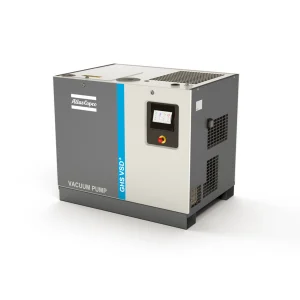 GHS 350 VSD+Pumping speed 400 m³/h 50 Hz400 m³/h 60 HzUltimate pressure 0.35 mbarRated motor power 5.5 kW 50 Hz5.5 kW 60 HzVariants 29
 GHS 402 VSD+Pumping speed 467 m³/h 50 Hz467 m³/h 60 HzUltimate pressure 0.35 mbarRated motor power 5.5 – 7.5 kW 50 Hz5.5 – 7.5 kW 60 HzVariants 4GHS 585 VSD+Pumping speed 560 m³/h 50 Hz560 m³/h 60 HzUltimate pressure 0.35 mbarRated motor power 7.5 kW 50 Hz7.5 kW 60 HzVariants 30GHS 602 VSD+Pumping speed 640 m³/h 50 Hz640 m³/h 60 HzUltimate pressure 0.35 mbarRated motor power 7.5 – 11 kW 50 Hz7.5 – 11 kW 60 HzVariants 4GHS 730 VSD+Pumping speed 730 m³/h 50 Hz730 m³/h 60 HzUltimate pressure 0.35 mbarRated motor power 11 kW 50 Hz11 kW 60 HzVariants 30GHS 752 VSD+Pumping speed 805 m³/h 50 Hz805 m³/h 60 HzUltimate pressure 0.35 mbarRated motor power 11 – 15 kW 50 Hz11 – 15 kW 60 HzVariants 4GHS 900 VSD+Pumping speed 870 m³/h 50 Hz870 m³/h 60 HzUltimate pressure 0.35 mbarRated motor power 15 kW 50 Hz15 kW 60 HzVariants 32GHS 902 VSD+Pumping speed 917 m³/h 50 Hz917 m³/h 60 HzUltimate pressure 0.35 mbarRated motor power 15 – 18.5 kW 50 Hz15 – 18.5 kW 60 HzVariants 4GHS 1002 VSD+Pumping speed 1,039 m³/h 50 Hz1,039 m³/h 60 HzUltimate pressure 0.35 mbarRated motor power 18.5 kW 50 Hz18.5 kW 60 HzVariants GHS 1202 VSD+Pumping speed 1,172 m³/h 50 Hz1,172 m³/h 60 HzUltimate pressure 0.3 mbarRated motor power 18.5 kW 50 Hz18.5 kW 60 HzVariants 9GHS 1300 VSD+Pumping speed 1,250 – 1,615 m³/h 50 Hz1,250 – 1,615 m³/h 60 HzUltimate pressure 0.35 mbarRated motor power 18 – 22 kW 50 Hz18 – 22 kW 60 HzVariants 33GHS 1402 VSD+Pumping speed 1,383 m³/h 50 Hz1,383 m³/h 60 HzUltimate pressure 0.3 mbarRated motor power 22 kW 50 Hz22 kW 60 HzVariants 9GHS 1602 VSD+Pumping speed 1,581 m³/h 50 Hz1,581 m³/h 60 HzUltimate pressure 0.3 mbarRated motor power 30 kW 50 Hz30 kW 60 HzVariants 9GHS 1600 VSD+Pumping speed 1,590 – 1,811 m³/h 50 Hz1,590 – 1,811 m³/h 60 HzUltimate pressure 0.35 mbarRated motor power 28 – 30 kW 50 Hz28 – 30 kW 60 HzVariants 33GHS 2002 VSD+Pumping speed 1,771 m³/h 50 Hz1,771 m³/h 60 HzUltimate pressure 0.3 mbarRated motor power 37 kW 50 Hz37 kW 60 HzVariants 9GHS 1900 VSD+Pumping speed 1,810 m³/h 50 Hz1,810 m³/h 60 HzUltimate pressure 0.35 mbarRated motor power 37 kW 50 Hz37 kW 60 HzVariants 21GHS 2700 VSD+Pumping speed 2,674 m³/h 50 Hz2,674 m³/h 60 HzUltimate pressure 0.35 mbarRated motor power 45 kW 50 Hz45 kW 60 HzVariants 8GHS 3400 VSD+Pumping speed 3,268 m³/h 50 Hz3,268 m³/h 60 HzUltimate pressure 0.35 mbarRated motor power 55 kW 50 Hz55 kW 60 HzVariants 8GHS 3800 VSD+Pumping speed 3,724 m³/h 50 Hz3,724 m³/h 60 HzUltimate pressure 0.35 mbarRated motor power 55 kW 50 Hz55 kW 60 HzVariants 9GHS 4600 VSD+Pumping speed 4,494 m³/h 50 Hz4,494 m³/h 60 HzUltimate pressure 0.35 mbarRated motor power 75 kW 50 Hz75 kW 60 HzVariants 9GHS 5400 VSD+Pumping speed 5,136 m³/h 50 Hz5,136 m³/h 60 HzUltimate pressure 0.35 mbarRated motor power 90 kW 50 Hz90 kW 60 HzVariants 9
Leybold NOVADRY series 4 models
 NOVADRY ND 65Pumping speed 63 m³/h 50 Hz63 m³/h 60 HzUltimate pressure 0.1 mbarRated motor power 1.5 kW 50 Hz1.5 kW 60 HzVariants 3
 NOVADRY ND 100Pumping speed 96 m³/h 50 Hz96 m³/h 60 HzUltimate pressure 0.1 mbarRated motor power 2.2 kW 50 Hz2.2 kW 60 HzVariants 3NOVADRY ND 160Pumping speed 138 m³/h 50 Hz138 m³/h 60 HzUltimate pressure 0.1 mbarRated motor power 3 kW 50 Hz3 kW 60 HzVariants 3NOVADRY ND 200Pumping speed 175 m³/h 50 Hz175 m³/h 60 HzUltimate pressure 0.1 mbarRated motor power 4 kW 50 Hz4 kW 60 HzVariants 3
No model matches these filters.
Atlas Copco GHS VSD+ series 21 models
Leybold NOVADRY series 4 models
Models a manufacturer no longer carries in its current range are listed in its “Outdated models” section.
Industries
Glass forming: where the manufacturers name it
The manufacturers list these uses on their own pages.
Glass, ceramics and stone
Atlas Copco describes glass forming in IS machines with the GHS VSD+ (150–300 mbar, 600–1,500 m³/h per machine); Leybold lists glass bottle forming for the NOVADRY.
Frequently asked questions
Glass forming: frequently asked questions
How does glass forming with vacuum work?
In the IS machine, the hot glass gob lies in the mould. Atlas Copco describes it as follows: the moulds are evacuated through fine holes, the air between the glass and the mould wall is drawn off, the glass settles against the mould faster, and less compressed air is needed.
Which vacuum pump for IS machines in the glass industry?
Atlas Copco names the GHS VSD+ screw vacuum pumps with frequency control for glass forming in IS machines. Leybold lists the NOVADRY dry screw vacuum pump for glass bottle forming without describing it in more detail.
How much vacuum does glass forming need?
Atlas Copco names 150–300 mbar at the mould.
How much pumping speed does an IS machine need?
Atlas Copco names 100–250 m³/h per section and 600–1,500 m³/h per IS machine, up to 4,000 m³/h.
Why vacuum instead of compressed air in glass forming?
According to Atlas Copco, vacuum forms faster and needs less compressed air; overall, Atlas Copco names up to five times less air and energy.
Oil-free or oil-lubricated for glass forming?
Atlas Copco names the oil-sealed GHS VSD+ screw vacuum pumps, Leybold the NOVADRY dry screw vacuum pump. Both designs are therefore named for glass forming.
What are the fine holes in the mould?
According to Atlas Copco, the air between the glass and the mould wall is drawn off through them. They are so fine that the glass does not enter them, but the air can escape.
Which vacuum pump for glass bottle forming?
Leybold lists glass bottle forming for the NOVADRY. For bottle forming in IS machines, Atlas Copco names the GHS VSD+ with 150–300 mbar at the mould.
A single pump or a central vacuum system?
A central system in a room of its own keeps noise and heat away from production and matches its output to the demand. Central vacuum systems are planned and built by Eugen Theis Vakuum, a company of the Ehrler & Beck group – more under Central Vacuum.
Does Ehrler & Beck also supply spare parts and service?
Yes. Ehrler & Beck offers original spare parts and accessories as well as maintenance and repair.
Which pump suits your process?
Tell us the application, the medium and the volume – we advise you on selection, spare parts and service.
