

CLAW PRESSURE/VACUUM PUMPS

Modern claw pressure/vacuum pumps operate oil-free: pressure and vacuum can be combined in a single claw stage. All operating points on the pressure and suction side work with intermediate charging of air (KLR series). Combined claw pumps are one of the most important parts of the market. Dry, contact-free operation and an integrated cooling system reduce operating costs to a minimum.
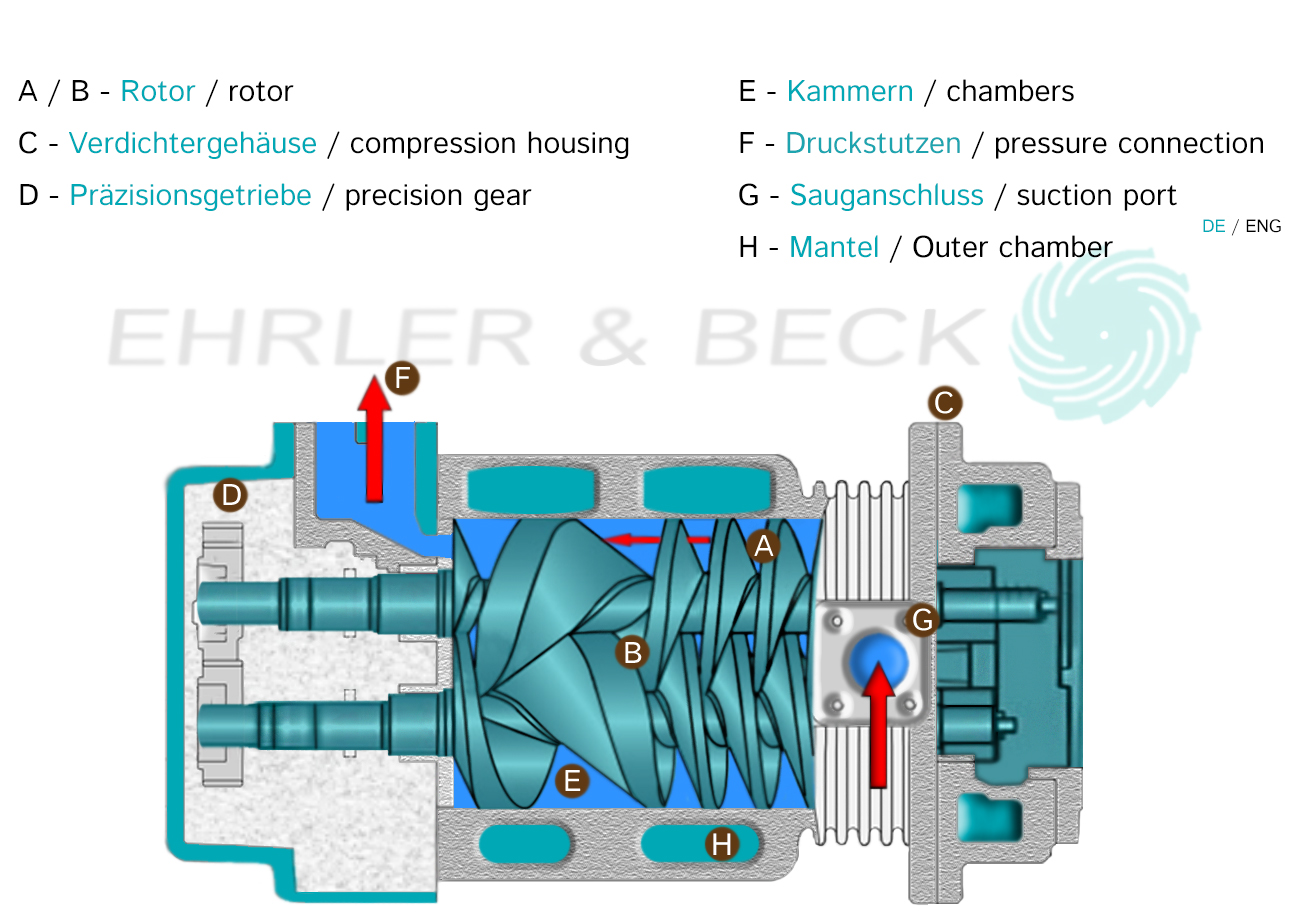
Like the rotary vane and rotary lobe vacuum pumps, the claw vacuum pump is based on a static compression system. Inside the compression housing (C), two rotors (E, F) rotate in opposite directions without contact and with very narrow clearances. They are synchronised by a precision gearbox. When the claw moves over the inlet connection (B) and the axial inlet channel opening (D), the gas is drawn into the compression chamber. As the rotors turn, the gas is transported from the inlet side to the discharge side, where it is compressed by reducing the volume between the rotors until the lower rotor uncovers the opening of the discharge channel (G). The pre-compressed gas is expelled through the discharge connection (H). The heat generated by the vacuum process is dissipated by cooling air, which is drawn through between the pump housing (C) and a sound-insulating hood (A).
*This description does not take into account each manufacturer’s approach to the technology, but is a generalised description that attempts to cover the basic operating principle.
THE EHRLER & BECK PRODUCT RANGE COMPRISES THE FOLLOWING SERIES:
PRESSURE/VACUUM PUMP TECHNOLOGIES